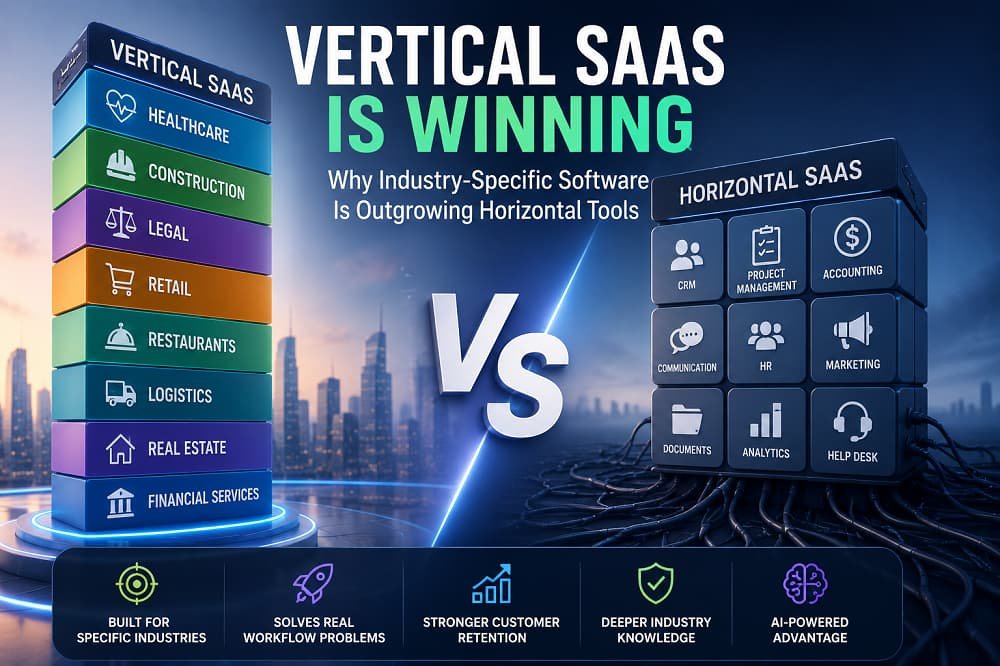
For years, the biggest software platforms followed a simple idea: build one powerful tool that can work for almost everyone.
Businesses used the same customer relationship management systems, project management platforms, accounting software, communication tools, and workflow applications regardless of their industry.
These products are known as horizontal SaaS.
But a major shift is taking place.
Businesses are increasingly looking for software that understands the specific way their industry works. Instead of adapting a general-purpose platform to fit their processes, they want technology designed around their workflows from the beginning.
This is where Vertical SaaS comes in.
From healthcare and construction to real estate, legal services, restaurants, logistics, and financial services, industry-specific software is becoming a powerful part of the SaaS market.
Vertical SaaS is not simply software with a different interface. The strongest platforms combine industry knowledge, specialized workflows, compliance requirements, data structures, and automation into a product built for a particular type of business.
In this article, we’ll explore why Vertical SaaS is growing, how it differs from horizontal software, and why industry-specific platforms are increasingly competing with—and sometimes outperforming—general-purpose tools.
Contents
- What Is Vertical SaaS?
- Vertical SaaS vs. Horizontal SaaS
- Why Businesses Are Moving Toward Industry-Specific Software
- Vertical SaaS Solves Real Workflow Problems
- Built-In Industry Knowledge Creates an Advantage
- Customization Is No Longer the Best Answer
- Vertical SaaS Can Become the System of Record
- AI Is Accelerating the Growth of Vertical SaaS
- Why Vertical SaaS Can Build Stronger Customer Relationships
- The Business Advantages of Vertical SaaS
- Challenges Facing Vertical SaaS Companies
- How to Know Whether Vertical SaaS Is Right for Your Business
- The Future of Vertical SaaS
- Frequently Asked Questions
What Is Vertical SaaS?
Vertical SaaS refers to cloud-based software designed specifically for a particular industry or market.
Instead of trying to serve every type of business, a Vertical SaaS company focuses on the unique needs of a specific group of customers.
For example, a general project management platform may be used by marketing teams, software companies, agencies, and manufacturers.
A construction-specific software platform, on the other hand, may include features designed for:
- Project estimates
- Job costing
- Contractor management
- Construction schedules
- Site documentation
- Change orders
- Equipment tracking
- Safety reporting
Both products may help manage projects, but the vertical platform is designed around the actual workflow of one industry.
That difference is important.
Vertical SaaS does not ask the customer to adapt their business to the software.
Instead, the software is built around the way the business already operates.
Vertical SaaS vs. Horizontal SaaS
The easiest way to understand Vertical SaaS is to compare it with horizontal software.
Horizontal SaaS
Horizontal SaaS products are designed to solve a common business problem across many industries.
Examples include tools for:
- Communication
- Project management
- Customer relationship management
- Accounting
- Marketing
- Document management
- Human resources
A horizontal platform can serve a large market because nearly every business needs these functions.
However, businesses often need to customize the platform, connect additional tools, or create manual processes to make it fit their industry.
Vertical SaaS
Vertical SaaS focuses on a narrower market.
The product is designed around:
- Industry terminology
- Specialized workflows
- Regulatory requirements
- Customer expectations
- Industry-specific data
- Operational processes
A healthcare practice does not operate like a construction company.
A law firm does not operate like a restaurant.
A logistics company does not have the same workflow as a real estate agency.
Vertical SaaS recognizes these differences and builds them directly into the product.
The Simple Difference
Horizontal SaaS: One solution for many industries.
Vertical SaaS: A specialized solution for one industry or market.
Why Businesses Are Moving Toward Industry-Specific Software
Businesses have become more dependent on software than ever before.
But as companies add more digital tools, a new problem appears: software fragmentation.
A business may use one platform for customer information, another for payments, another for scheduling, another for communication, and several more for reporting and internal operations.
These systems may not work together perfectly.
Employees are then forced to move information between different applications.
This creates problems such as:
- Duplicate data
- Manual work
- Higher software costs
- Training difficulties
- Reporting challenges
- Workflow errors
- Poor visibility
Vertical SaaS companies can address these problems by combining multiple industry-specific functions into a single platform.
Instead of assembling ten different tools, a business may be able to manage a larger part of its workflow through one specialized system.
That can make operations simpler and more efficient.
Vertical SaaS Solves Real Workflow Problems
One of the biggest advantages of Vertical SaaS is that it focuses on specific operational problems.
A general software platform may provide flexible features.
But flexibility often comes with complexity.
The customer may need to configure:
- Fields
- Automations
- Dashboards
- Reports
- Permissions
- Integrations
- Workflows
This can be useful for large organizations with technical teams.
However, many businesses do not want to spend months building their own software environment.
They want a product that already understands their needs.
For example, a salon owner may not simply need a calendar.
They may need:
- Appointment scheduling
- Customer profiles
- Staff scheduling
- Payment processing
- Automated reminders
- Inventory management
- Membership programs
A specialized platform can combine these functions into a workflow designed for that specific type of business.
The value is not just in having more features.
The value is in having the right features connected in the right way.
Built-In Industry Knowledge Creates an Advantage
Vertical SaaS companies can develop deep knowledge about their customers.
Over time, they learn:
- How customers make money
- What problems slow them down
- Which tasks are repetitive
- What information they need
- Which regulations affect them
- Where mistakes commonly happen
This knowledge becomes part of the product.
A Vertical SaaS company serving legal professionals, for example, can build workflows around the specific way legal work is organized.
A company serving healthcare providers can design features around the needs of medical practices.
A platform serving restaurants can focus on operations that matter to restaurant owners.
This industry expertise can become a major competitive advantage.
A horizontal software company can build general features.
A vertical company can build features based on a deep understanding of a specific customer’s daily reality.
Customization Is No Longer the Best Answer
For a long time, businesses solved the limitations of horizontal software through customization.
If the software did not support a workflow, the company could:
- Add integrations
- Build custom automations
- Use spreadsheets
- Hire developers
- Create internal processes
But customization has costs.
Every custom workflow can create additional complexity.
Over time, businesses may find themselves managing a complicated collection of software, integrations, and workarounds.
Vertical SaaS offers a different approach.
Instead of starting with a general platform and customizing everything, the business starts with software that already includes many of the workflows it needs.
This can reduce implementation time and make the platform easier for employees to use.
Of course, no software will perfectly fit every business.
But companies increasingly prefer a product that covers 80 or 90 percent of their needs immediately rather than one that requires extensive customization before it becomes useful.
Vertical SaaS Can Become the System of Record
One of the biggest opportunities for Vertical SaaS companies is becoming the central system a business relies on.
This is often called the system of record.
A system of record stores important operational data and becomes deeply connected to how the business works.
For example, an industry-specific platform might manage:
- Customers
- Transactions
- Employees
- Projects
- Documents
- Appointments
- Inventory
- Payments
The more important workflows a platform manages, the more valuable it can become to the customer.
This also creates a stronger relationship between the software company and the business.
Once a platform becomes deeply integrated into daily operations, replacing it can be difficult.
This does not mean customers should be trapped.
It means the platform provides significant value because it has become an important part of how the business operates.
For SaaS companies, this can create stronger long-term customer relationships.
AI Is Accelerating the Growth of Vertical SaaS
Artificial intelligence is creating another major opportunity for Vertical SaaS.
General AI tools can perform broad tasks such as:
- Writing
- Summarizing
- Analyzing information
- Generating content
- Answering questions
But AI becomes more useful when it understands the context in which it is being used.
This is where vertical platforms have an advantage.
A specialized AI assistant can potentially work with industry-specific information, workflows, and terminology.
For example, AI within a vertical platform could help users:
- Summarize customer interactions
- Generate industry-specific documents
- Identify operational issues
- Automate repetitive workflows
- Organize specialized information
- Provide context-aware suggestions
The important difference is context.
A general AI tool may understand language.
A vertical AI system can potentially understand the language and the workflow of a specific industry.
This could make AI more practical for everyday business operations.
Why Vertical SaaS Can Build Stronger Customer Relationships
Horizontal software companies often compete on features.
Vertical SaaS companies can compete on understanding.
When a software provider understands a customer’s industry, it can become more than just a technology vendor.
It can become a trusted operational partner.
Customers may expect the company to understand:
- Industry trends
- Compliance requirements
- Common challenges
- Best practices
- Changing customer expectations
This relationship can lead to stronger customer loyalty.
A business may be less likely to switch platforms if the existing software is deeply connected to its operations and continues to evolve alongside the industry.
The strongest Vertical SaaS companies often create value through a combination of:
Software + Industry Knowledge + Data + Workflow Integration
This is more difficult to replicate than a simple feature list.
The Business Advantages of Vertical SaaS
Vertical SaaS can offer several important advantages for both customers and software companies.
1. Higher Relevance
The product is designed for a specific customer.
This can make the features more useful and easier to understand.
2. Faster Implementation
Businesses may spend less time configuring the platform.
Industry-specific workflows may already be built into the software.
3. Better Customer Retention
When software becomes deeply connected to daily operations, customers may have stronger reasons to continue using it.
4. Clearer Product Positioning
A company serving a specific industry can often communicate its value more clearly.
Instead of saying:
“We help businesses manage their operations.”
It can say:
“We help dental practices manage appointments, patients, billing, and daily operations.”
The second message is much easier for the target customer to understand.
5. Opportunities for Expansion
Once a Vertical SaaS company becomes trusted within an industry, it may expand into additional services such as:
- Payments
- Financial services
- Marketing
- Analytics
- Insurance
- Marketplace services
- AI automation
This can increase the value of each customer relationship.
Why Payments and Financial Services Are Important
Many Vertical SaaS companies are expanding beyond traditional software subscriptions.
If a platform already manages business operations, it may also be able to support transactions.
For example, a platform that manages appointments could potentially support payments.
A platform that manages invoices could potentially support billing.
A system that tracks business activity could potentially provide financial insights.
This creates an opportunity to build a more complete business platform.
The software company is no longer only selling a subscription.
It can become part of the economic infrastructure of the industry it serves.
This is one reason why Vertical SaaS can become especially powerful.
The closer a platform gets to the core operations of a business, the more opportunities it may have to create additional value.
Challenges Facing Vertical SaaS Companies
Vertical SaaS is not automatically successful.
Building software for a specific industry also creates challenges.
Smaller Addressable Markets
A horizontal platform may sell to almost any business.
A vertical platform focuses on a smaller market.
This means the company needs to understand whether the target industry is large enough to support long-term growth.
Deep Industry Knowledge Is Required
It is not enough to add industry-specific words to a general product.
A successful Vertical SaaS company needs to understand how customers actually work.
This often requires close relationships with users and continuous feedback.
Complex Regulations
Some industries have strict rules regarding:
- Data
- Privacy
- Security
- Compliance
- Record keeping
Vertical software companies may need to invest heavily in meeting these requirements.
Industry Changes
Industries evolve.
New regulations, technologies, and customer expectations can require the software to change quickly.
A Vertical SaaS company must continue investing in product development to remain relevant.
How to Know Whether Vertical SaaS Is Right for Your Business
If you are choosing software for your business, consider these questions.
Does your industry have specialized workflows?
If your business uses processes that general software struggles to support, a vertical platform may be useful.
Are you using too many disconnected tools?
A specialized platform may reduce the number of applications your team needs.
Are employees spending time on manual workarounds?
If staff regularly export, copy, and move data between systems, a more integrated solution may improve efficiency.
Do regulations affect your business?
Industry-specific software may offer features designed around compliance requirements.
Do you need flexibility or specialization?
Some businesses need highly customizable tools because their workflows are unique.
Others benefit more from software that already understands the standard processes of their industry.
The best choice depends on your business.
Vertical SaaS is not always better than horizontal SaaS.
The question is whether specialization creates enough value to justify using a dedicated platform.
The Future of Vertical SaaS
The future of SaaS may become increasingly specialized.
Instead of a small number of general software platforms serving every industry, we may see more companies building deeply focused solutions for specific markets.
The next generation of Vertical SaaS may combine:
- Industry-specific software
- AI assistants
- Automation
- Payments
- Analytics
- Communication
- Marketplaces
- Financial tools
The result could be a more complete operating system for individual industries.
Imagine a platform that does not simply manage a business process.
Instead, it helps run the entire business.
That is the larger opportunity behind Vertical SaaS.
As software becomes more capable, customers may increasingly expect technology to understand the context of their work rather than forcing them to adapt to generic systems.
Frequently Asked Questions
What is Vertical SaaS?
Vertical SaaS is cloud-based software designed specifically for a particular industry, profession, or market. It includes features and workflows built around the needs of that specific type of customer.
What is the difference between Vertical SaaS and Horizontal SaaS?
Horizontal SaaS serves businesses across many industries and focuses on general problems, such as communication or project management.
Vertical SaaS focuses on one industry and provides specialized tools for its workflows, terminology, and operational needs.
Why is Vertical SaaS growing?
Businesses increasingly want software that requires less customization and better supports their specific workflows. Vertical SaaS can combine specialized features, industry knowledge, automation, and operational data in one platform.
Is Vertical SaaS better than Horizontal SaaS?
Not always.
Vertical SaaS may be a better choice when a business has specialized workflows or industry requirements. Horizontal SaaS may be better when flexibility, broad integrations, and cross-industry functionality are more important.
How does AI affect Vertical SaaS?
AI can become more useful when combined with industry-specific context. Vertical SaaS platforms may use AI to automate workflows, analyze specialized data, generate documents, and provide more relevant assistance.
Can Vertical SaaS companies expand into other services?
Yes. Some Vertical SaaS companies may expand beyond subscriptions into areas such as payments, analytics, financial services, automation, or marketplace services.
Final Thoughts
The growth of Vertical SaaS reflects a simple change in what businesses expect from software.
Companies no longer want technology that merely provides a collection of generic features.
They increasingly want software that understands how they work.
That is the strength of Vertical SaaS.
By focusing on a specific industry, companies can build products around real workflows, industry knowledge, specialized data, and the everyday challenges their customers face.
Horizontal tools will continue to play an important role, especially for broad business functions.
But the opportunity for Vertical SaaS is becoming increasingly clear.
The future of business software may not belong only to the platforms that serve everyone. It may also belong to the platforms that understand one industry better than anyone else.